Case Studies
Please give us a call if you have any questions about our products and services.
VisionCTS
690 Kintner Parkway
Sunbury, OH 43074
(800) 596-1992
Take the Next Step
OBJECTIVE:
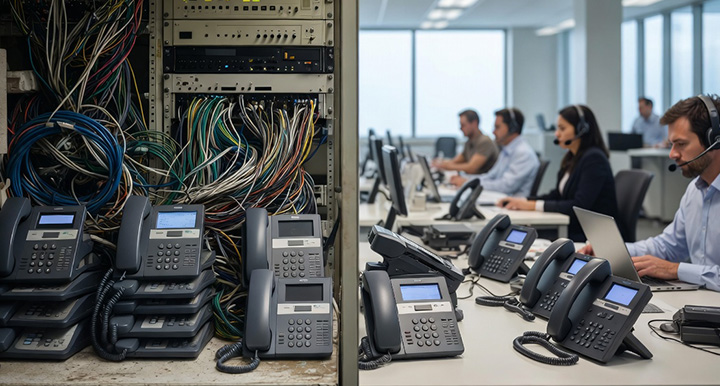
A business was evaluating whether to replace its aging on-premise phone system or move to a hosted voice platform. The challenge was helping leadership understand not only the technology differences, but also the long-term operational and financial impact of each approach.
Primary Issues to Resolve
For years, businesses purchased and maintained their own phone systems because there were few practical alternatives. This approach was very similar to how companies once managed their own Microsoft Exchange email servers. While effective at the time, maintaining on-premise systems requires ongoing investment in hardware, software, security, backups, and specialized support.
The question became simple: Why are businesses still managing phone systems the way they managed email twenty years ago?
Issue 1: Hardware Ownership and Lifecycle Management – An on-premise PBX requires servers, licensing, maintenance, software updates, backups, and eventual replacement. As systems age, support becomes more difficult and replacement parts become scarce.
Issue 2: Security, Reliability, and Maintenance Responsibility – With an on-premise system, the business is responsible for keeping software current, protecting against vulnerabilities, maintaining backups, and ensuring the system remains operational.
Issue 3: Limited Flexibility for Modern Business Needs – Adding remote workers, new locations, mobile users, or advanced features often requires additional hardware, licensing, and configuration.
SOLUTION IMPLEMENTED
Evaluated the phone system using the same logic businesses apply to email – Years ago, many organizations operated their own Microsoft Exchange servers. At the time, the idea of placing company email in someone else's data center seemed risky. Businesses invested heavily in servers, backups, antivirus software, maintenance contracts, and disaster recovery planning.Today, most organizations happily use Microsoft 365. They no longer worry about server hardware, operating system updates, backup strategies, security patches, or replacing failed drives at 2:00 AM. They simply use email.
Applied the same philosophy to voice communications – Hosted voice moves the responsibility for infrastructure, maintenance, software updates, security, and platform management to the provider. The customer retains all the functionality they need while eliminating much of the overhead associated with ownership.
Improved scalability and flexibility – Adding users, supporting remote employees, opening new locations, or enabling mobile applications becomes significantly easier when the communications platform is already designed to operate beyond the walls of a single building.
Reduced long-term operational burden – Rather than budgeting for future hardware replacements, software upgrades, and maintenance contracts, the customer gains predictable monthly costs and a platform that continually evolves without requiring major capital investments.
Results
The customer ultimately recognized that the conversation wasn't really about phones. It was about deciding whether they wanted to own and maintain communications infrastructure or simply use communications as a service.
Just as Microsoft 365 transformed the way businesses think about email, hosted voice is changing the way businesses think about phone systems. Most organizations no longer want the responsibility, security risk, maintenance burden, or capital expense associated with operating their own communications platform. They simply want reliable service, modern features, and a trusted partner managing the technology behind the scenes.
Today, very few businesses would choose to build and maintain their own email server. Increasingly, they're asking the same question about their phone system.

Find out more about our Managed I.T. Services and Solutions.
690 Kintner Parkway - Sunbury, OH 43074 - (800) 596-1992
© 2026 · Vision Cloud Telephone Service · All Rights Reserved -